
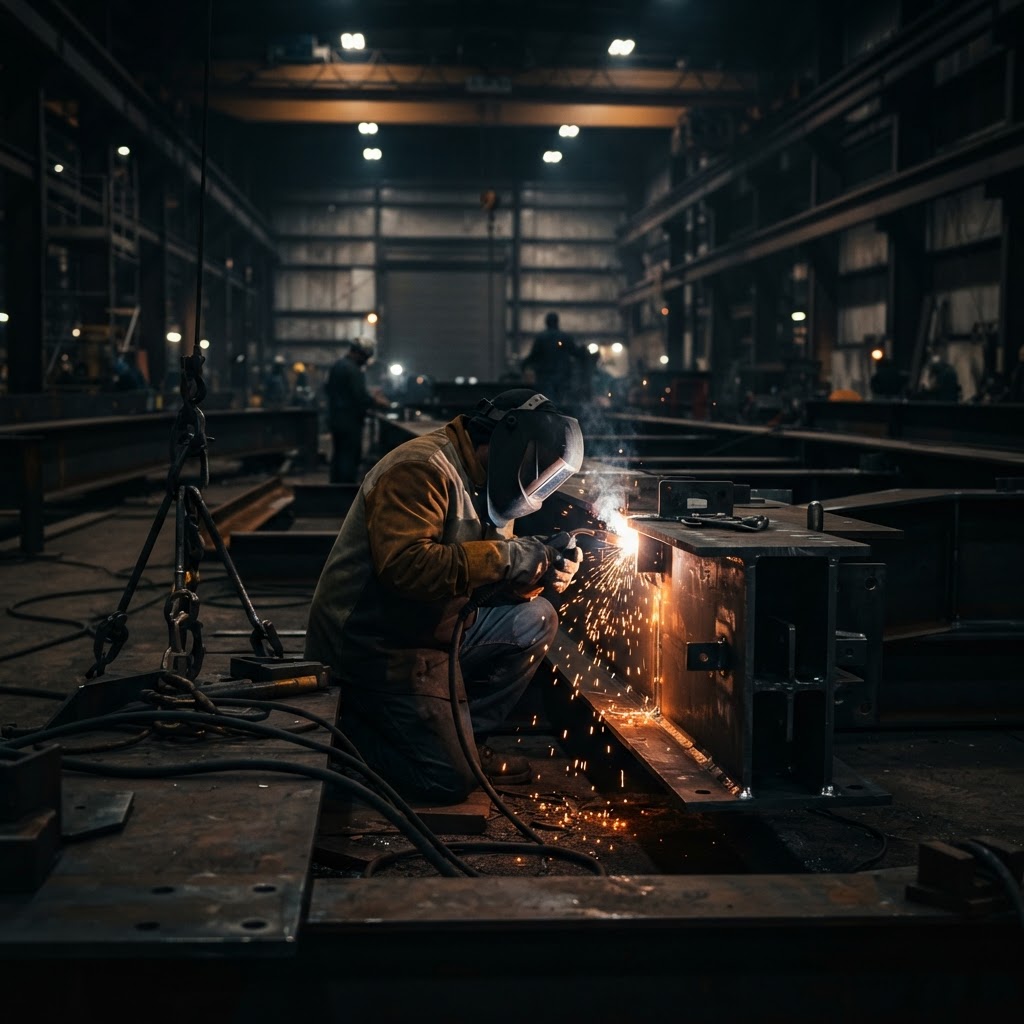
What AISC Certification Actually Tells You About a Steel Fabricator
When a general contractor or DOT project manager searches for a "welding shop near me" or starts vetting fabricators for a structural steel package, the conversation often turns quickly to certifications. AISC certification comes up constantly, but many buyers of fabrication services don't fully understand what it covers, what it doesn't, and why it matters for schedule, quality, and liability on a project. This article breaks down what AISC certification really means, how it differs from general welding capability, and what questions you should be asking any fabricator before you award a contract.
AISC Certification Is a Process Audit, Not a Marketing Badge
The American Institute of Steel Construction (AISC) Quality Certification Program is not a one-time test. It's an ongoing audit of a fabricator's entire management system, covering everything from how a project moves through estimating and detailing, to material traceability, welding procedures, and final inspection before shipment.
A certified shop has demonstrated, through a rigorous third-party audit, that it has documented procedures for:
- Contract review and engineering coordination
- Material receiving, identification, and traceability
- Welder qualification and continuity records
- Nondestructive testing (NDT) protocols
- Dimensional and visual inspection before shipment
- Corrective action processes when nonconformances occur
Re-certification happens on a recurring cycle, meaning the audit isn't a historical snapshot — it reflects current, ongoing practice. For a GC or owner, this matters because it shifts quality assurance from "trust me" to "show me the documentation," which is exactly what you want on a project where steel members carry life-safety loads.
The Difference Between Certification Categories
Not all AISC certifications are identical. There are distinct categories, including Simple Steel Buildings, Major Steel Buildings, Bridge and Highway Structures (with sub-endorsements for fracture-critical and non-fracture-critical members), and Sophisticated Paint Endorsements for specialized coatings. A fabricator certified for conventional building steel is not automatically qualified for fracture-critical bridge girders. If your project involves bridge work, confirm the specific endorsement — this is one of the most common gaps that surfaces late in bidding when it should have been caught during prequalification.
Why Welding Quality Control Goes Beyond the Welder's Skill
A skilled welder is necessary but not sufficient for consistent structural quality. Weld quality on a certified project is actually a system output, built from several layers:
Welding Procedure Specifications (WPS) define the parameters — amperage, voltage, travel speed, preheat, joint design — for every weld type on the job. These procedures must be qualified through testing (PQR) before they're used in production, not written after the fact.
Welder qualification records confirm that each individual welder has passed testing for the specific process, position, and material thickness they'll be performing. Continuity logs track whether a welder has maintained active qualification, since gaps in practice can lapse a certification.
Nondestructive testing — ultrasonic testing (UT), magnetic particle testing (MT), or radiographic testing (RT) — verifies weld integrity on critical joints according to the project's NDT plan, which is typically driven by AWS D1.1 (structural) or AWS D1.5 (bridge) code requirements.
For a DOT contractor, this layered system is why bridge fabrication carries more stringent documentation requirements than typical commercial steel. Fracture-critical members, in particular, require enhanced welder qualification, additional NDT, and often a Fracture Control Plan that governs material selection, fabrication sequencing, and inspection frequency.
What to Ask For During Bidding
Estimators reviewing fabricator qualifications should request copies of current AISC certification scope letters (not just a logo on a website), welding procedure specifications relevant to the project's material and joint types, and a sample quality control manual or inspection checklist. A fabricator confident in its systems will have these readily available.
Material Traceability: The Paper Trail That Protects Everyone
One of the less visible but critically important parts of certified fabrication is Material Test Report (MTR) traceability. Every piece of structural steel should be traceable back to its heat number and the mill certification confirming its chemical composition and mechanical properties meet the specified ASTM grade.
This matters for several practical reasons. If a structural issue is ever discovered after erection, traceability allows engineers to identify exactly which heat of material was used and whether it met specification. It also protects against counterfeit or substandard material entering the supply chain, a real risk during periods of material shortages when buyers are tempted to source from unverified suppliers.
For DOT projects specifically, Buy America provisions add another layer of documentation, requiring proof that steel melting and manufacturing occurred domestically. A fabricator with mature traceability systems should be able to produce this documentation quickly without disrupting production schedules — a sign of organizational maturity worth evaluating during prequalification.
Shop Capacity and Its Effect on Schedule Reliability
Contractors often underestimate how much shop capacity affects actual delivery dates versus quoted lead times. A facility's square footage, crane capacity, and equipment list determine not just what size members it can handle, but how many projects it can run simultaneously without bottlenecking.
When evaluating a fabricator for a project with a tight schedule, ask about:
- Current backlog and realistic start dates, not just lead time from order
- Crane capacity relative to your heaviest members
- In-house capabilities (cutting, drilling, welding, blasting, painting) versus outsourced processes, since each outsourced step adds schedule risk and a handoff point where quality control can slip
A shop that handles blasting and coating in-house, for example, removes a logistics variable that can otherwise delay shipment by days or weeks, particularly if a subcontracted coating facility has its own backlog.
Planning Ahead: What This Means for Your Next Bid
Whether you're a GC estimator pricing a design-build package, a DOT project manager prequalifying bridge fabricators, or an engineer specifying fabrication requirements, the underlying principle is the same: certification and documentation exist to reduce risk and variability. They give you a framework for verifying quality before steel ever leaves the shop, rather than discovering problems during erection or, worse, in service.
The practical takeaway is to treat certification verification, WPS review, and traceability confirmation as standard parts of your prequalification process — not optional extras. A fabricator that willingly provides this documentation and can speak knowledgeably about its own quality systems is signaling the kind of organizational discipline that translates directly into fewer field issues, fewer change orders, and a smoother path from shop drawing approval to final inspection.