
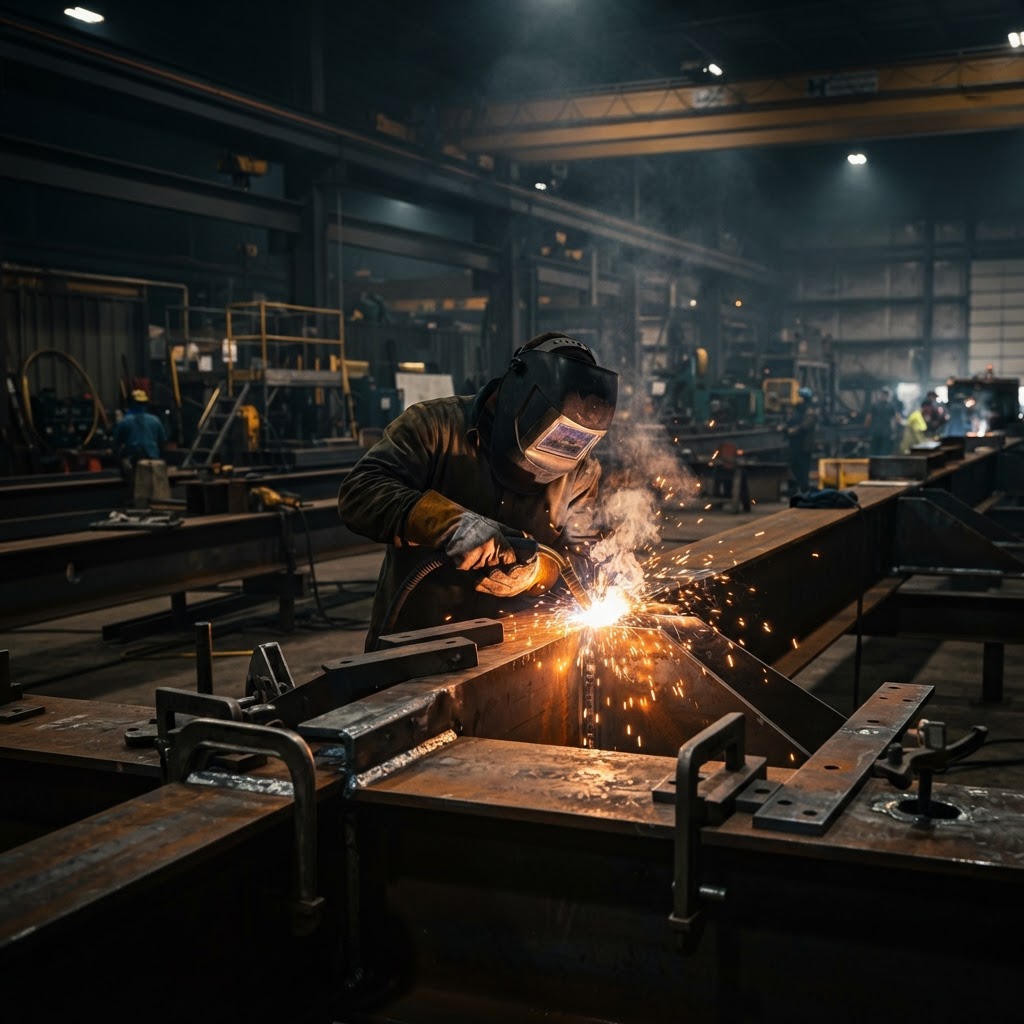
What GCs, Engineers, and DOT Project Managers Should Know Before Selecting a Steel Fabricator
When a project calls for structural steel or bridge components, the fabricator you choose has as much impact on schedule and long-term performance as the design itself. Yet many owners and estimators evaluate fabrication shops the same way they'd evaluate any subcontractor — by price and availability alone. That approach misses critical factors that determine whether steel arrives on site correctly fabricated, on time, and able to pass inspection without rework.
Whether you're a general contractor bidding a commercial build, a DOT project manager overseeing a bridge replacement, or an engineer specifying connections, understanding how fabrication quality is verified — and what separates a capable shop from a marginal one — will save you money and headaches down the line.
Understanding AISC Certification and Why It Matters
The American Institute of Steel Construction (AISC) Quality Certification Program is one of the few third-party audited standards specific to structural steel fabrication. It's not a marketing badge — it's an operational framework.
What the Certification Actually Audits
An AISC-certified fabricator has been evaluated on documented procedures for material traceability, welding procedure specifications (WPS), welder qualification records, dimensional tolerances, and internal quality control checkpoints. Auditors review actual shop records, not just policies on paper. Categories matter too — a shop certified for "Major Steel Bridges" (CBR) has been vetted specifically for bridge fabrication, which carries tighter tolerances and more rigorous documentation than standard building fabrication (SBD).
Why Specifiers Should Care
Many state DOTs and federal projects require AISC certification as a bid qualification, not a preference. For private commercial work, it isn't always mandated, but it functions as a proxy for a shop's internal discipline. A certified fabricator has demonstrated it can produce consistent, traceable, code-compliant steel — which reduces the risk of failed inspections, rejected welds, or delays caused by incomplete mill certs.
Bridge Fabrication Has Its Own Rulebook
Bridge steel is not simply "bigger building steel." DOT contractors and engineers working on bridge projects should understand a few distinctions that affect both bid evaluation and schedule expectations.
Fatigue and Fracture-Critical Considerations
Bridge members are subject to cyclical loading in ways most building steel is not. This means welding procedures must account for fatigue categories, and certain members may be classified as fracture-critical, requiring enhanced testing (such as Charpy V-Notch impact testing on base material) and stricter nondestructive examination (NDE) protocols, including ultrasonic and magnetic particle testing beyond what's typical in commercial fabrication.
AASHTO and State DOT Specifications
Bridge fabricators typically work to AASHTO/AWS D1.5 Bridge Welding Code rather than the D1.1 Structural Welding Code used for buildings. The two codes overlap but diverge on qualification requirements, preheat, and inspection frequency. A shop experienced in both codes will flag these distinctions early in shop drawing review rather than discovering conflicts mid-fabrication.
Coating and Corrosion Protection
Because bridge members are exposed to weather, deicing chemicals, and moisture cycling for decades, coating systems (galvanizing, metallizing, or multi-coat paint systems) are specified with particular care. Fabricators need to understand how surface preparation and coating application sequencing affects both the coating warranty and the structural coating specification called out in the contract documents.
Evaluating Shop Capacity and Capability Honestly
Square footage and equipment lists are easy to publish, but they don't tell the whole story about whether a shop can actually execute your project on schedule.
Questions Worth Asking During Bid Evaluation
How many welders are AWS-certified for the positions and processes your project requires? What's the shop's current backlog, and how does that align with your required delivery dates? Does the shop have in-house detailing capability, or does it outsource shop drawings — and if outsourced, how does that affect RFI turnaround?
These questions matter more than raw tonnage capacity. A shop that's overcommitted, even with excellent equipment, will struggle to hit delivery windows, and steel delivery delays cascade into erection schedule delays that are difficult to recover.
Material Sourcing and Mill Certifications
Traceability starts at the mill. A fabricator should be able to produce mill test reports (MTRs) tying every piece of structural steel back to its heat number, confirming it meets the specified ASTM grade. For DOT work especially, Buy America compliance documentation needs to be airtight — this is one of the more common sources of project delay when overlooked early.
Weld Quality Control: What Good Documentation Looks Like
Weld quality isn't just about a clean bead — it's about documented process control that can be verified after the fact.
Welding Procedure Specifications and Welder Qualifications
Every weld type used on a project should trace back to a qualified WPS supported by a Procedure Qualification Record (PQR), and every welder performing that weld should have a current qualification for that specific process and position. A shop with a well-organized WPS/PQR library, updated welder continuity logs, and documented periodic requalification is signaling operational maturity that reduces risk for the GC or owner relying on that steel.
Nondestructive Testing and Third-Party Inspection
Depending on the project specification, NDE may include visual inspection (VT), magnetic particle testing (MT), ultrasonic testing (UT), or radiographic testing (RT). Understanding which welds require which inspection level — and confirming the fabricator has either in-house certified inspectors (CWI) or a reliable third-party inspection relationship — should be part of pre-award due diligence, not a surprise during fabrication.
Planning Around Lead Times and Logistics
Even a technically excellent fabricator can create schedule risk if lead times and shipping logistics aren't planned early.
Shop Drawing Review Cycles
The single biggest controllable variable in fabrication schedule is how quickly shop drawings move through submittal, review, and approval. Engaging the fabricator's detailing team early, and setting clear expectations for RFI turnaround, often saves more schedule time than any adjustment made on the shop floor.
Shipping and Site Access Constraints
Oversized structural members and bridge girders often require permitted loads, escort vehicles, and coordinated delivery windows. Fabricators who ship regionally and nationwide should be looped in on site access constraints, crane pick locations, and staging plans well before fabrication begins, not the week steel is ready to ship.
Conclusion
Selecting a structural steel or bridge fabricator is a technical decision with real consequences for schedule, cost, and long-term structural performance. AISC certification, code-specific bridge fabrication experience, documented weld quality control, and realistic capacity assessment are the factors that actually predict project outcomes — far more than a quoted price alone. For GCs, engineers, and DOT project managers evaluating fabrication partners in the Southeast or beyond, asking the right questions during bid review is the most effective risk-reduction tool available before steel ever hits the shop floor.