
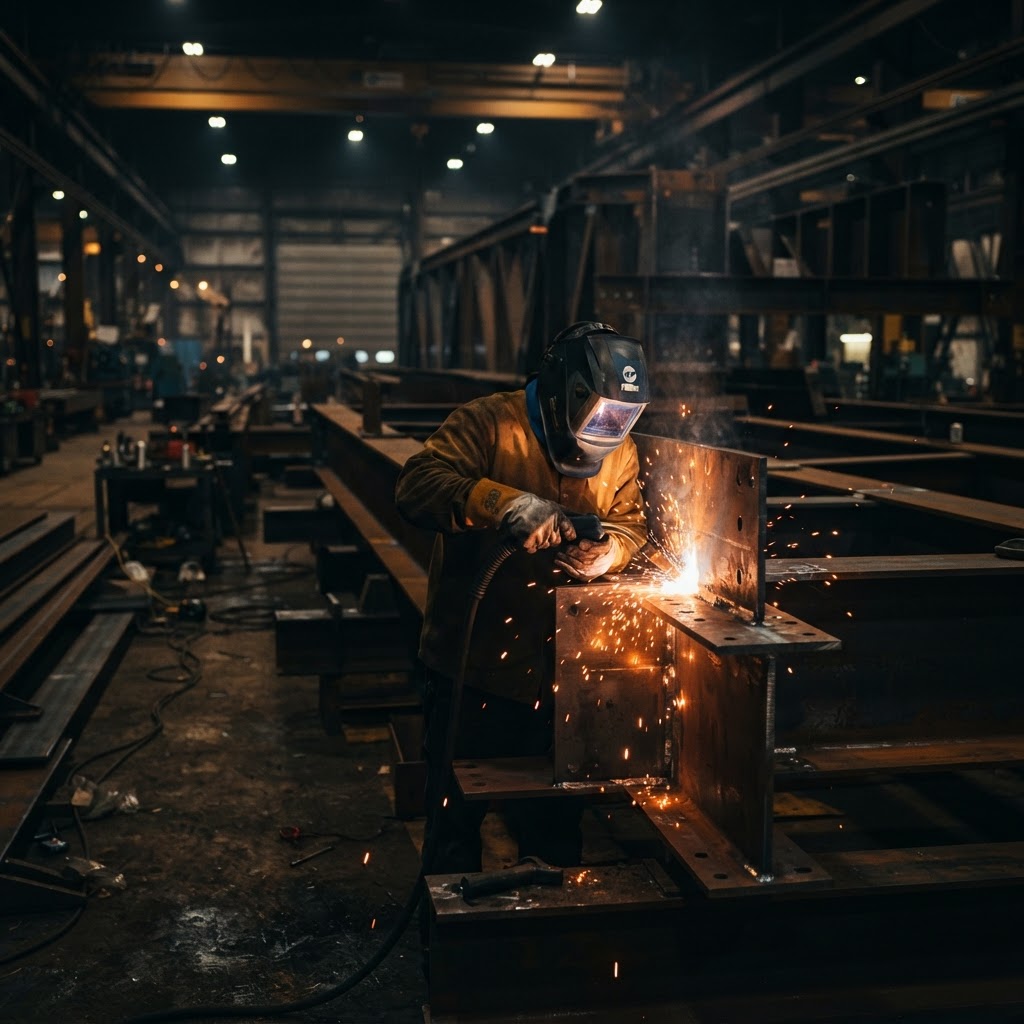
What General Contractors and DOT Project Managers Should Know Before Selecting a Structural Steel Fabricator
When a bid package lands on your desk with structural steel or bridge components in the scope, the fabricator you choose has a direct impact on schedule, safety, and long-term project performance. Yet many owners and GC estimators evaluate fabrication shops primarily on price and proximity, without fully understanding what separates a qualified fabricator from one that simply owns a welding machine. This article breaks down the key factors that should inform that decision.
Why AISC Certification Actually Matters
The American Institute of Steel Construction (AISC) certification program exists because "we can weld it" and "we can weld it correctly, consistently, and to code" are two very different claims. AISC certification is not a marketing badge — it's an independent, third-party audit of a fabricator's quality management system, personnel qualifications, equipment, and documented procedures.
What the Certification Categories Mean
AISC offers several certification categories, and understanding them helps you match a fabricator to your project's requirements:
- Sbd (Structural Steel Bridges) — required or preferred on most state DOT bridge projects, this category verifies a shop's ability to meet the more rigorous demands of bridge fabrication, including fracture-critical member handling where applicable.
- Cbr (Conventional Steel Bridges) — a related category focused on standard highway bridge components.
- Sbc (Structural Steel Buildings) — the baseline category for commercial and industrial building fabrication.
- Fracture Critical (Fcp) Endorsement — an additional layer of scrutiny for members whose failure would likely cause the structure to collapse, common in certain bridge girders.
Many state DOTs will not accept bids from shops without the appropriate AISC bridge certification, so confirming this early in the procurement process — not after award — saves significant schedule risk.
Understanding the Difference Between Structural and Miscellaneous Fabrication
Project specs often lump "steel fabrication" into a single line item, but structural steel and miscellaneous metals are governed by different codes, tolerances, and inspection requirements.
Structural steel — primary framing members, moment connections, bridge girders — typically falls under AWS D1.1 (Structural Welding Code – Steel) or AWS D1.5 (Bridge Welding Code) and AISC 360 specifications. These require qualified welding procedure specifications (WPS), welder qualification testing, and often third-party inspection.
Miscellaneous metals — stairs, handrails, embeds, and secondary framing — usually carry less stringent tolerance and inspection requirements, though they still require sound workmanship and often architectural finish considerations.
When a fabricator quotes both scopes under one number, it's worth asking how they're staffing and inspecting each differently. A shop with deep bridge experience will usually have separate quality control checkpoints for fracture-critical or primary structural welds versus secondary metals.
Bridge Fabrication: What Sets It Apart
Bridge work carries a different risk profile than building fabrication, and DOT specifications reflect that. A few areas worth understanding as a project owner or PM:
Weld Procedure and Personnel Qualification
Every weld procedure used on a bridge project must be qualified through documented testing (a Procedure Qualification Record, or PQR) before it's used in production, and welders must be individually tested and re-certified periodically. Ask your fabricator how recently their welders have been tested on the specific joint configurations your project requires.
Nondestructive Testing (NDT)
Bridge fabrication typically requires ultrasonic testing (UT), magnetic particle testing (MT), or radiographic testing (RT) on critical welds, performed by certified NDT technicians — sometimes third-party, sometimes in-house with independent verification. Understanding what percentage of welds will be tested, and by whom, should be clarified during the RFI phase, not after fabrication begins.
Charpy V-Notch Toughness Testing
For steel used in fracture-critical or primary bridge members, mill certifications must often demonstrate minimum Charpy V-Notch impact values at specified temperatures. This ensures the steel maintains ductility rather than becoming brittle in cold weather — a critical property for structures exposed to the elements for decades.
Material Traceability
DOT specs typically require full traceability of steel from mill certification through fabrication to final erection. A fabricator should be able to produce mill test reports (MTRs) tied to heat numbers for every piece of primary steel on the job, along with documentation showing which heat went into which member.
Evaluating Shop Capacity Before You Bid the Schedule
Beyond certifications and code compliance, physical shop capacity has a real impact on your project timeline. A few practical questions worth asking any fabricator during pre-bid or pre-award discussions:
- What is the shop's current backlog, and how does your project fit into the production schedule?
- What are the maximum plate thicknesses, beam lengths, and tonnage-per-week capacities of their equipment?
- Do they have in-house blasting and coating capability, or is that subcontracted (which adds a logistics step and potential schedule risk)?
- How do they handle oversized or overweight shipments, particularly for girders or trusses requiring permitted loads and escort vehicles?
A shop with a large, well-organized facility and established trucking relationships can often absorb schedule compression better than a smaller operation juggling multiple trades in the same space.
Quality Documentation: What to Request Up Front
Regardless of project size, it's reasonable — and increasingly expected — for owners and GCs to request the following before or during fabrication:
- Copies of AISC certification and scope of certification
- Welding Procedure Specifications and supporting PQRs for relevant joints
- Welder qualification records
- Mill test reports with heat number traceability
- NDT reports and inspector certifications
- Coating system data sheets, if applicable
Requesting this documentation isn't an accusation of poor quality — it's standard due diligence that protects everyone involved, including the fabricator, when questions arise years later during maintenance or inspection.
Conclusion
Selecting a structural steel or bridge fabricator involves more than comparing per-ton pricing. AISC certification, code compliance under AWS D1.1/D1.5, NDT protocols, material traceability, and shop capacity all directly affect whether a project stays on schedule and performs as designed for its intended service life. Taking the time to verify these factors during the bid and pre-construction phase — rather than discovering gaps mid-fabrication — is one of the most effective ways a GC estimator or DOT project manager can reduce risk on any steel-intensive project.